← Stories

The Upside-Down Visitor

Discover more

Swipe to turn the page · Scroll to read
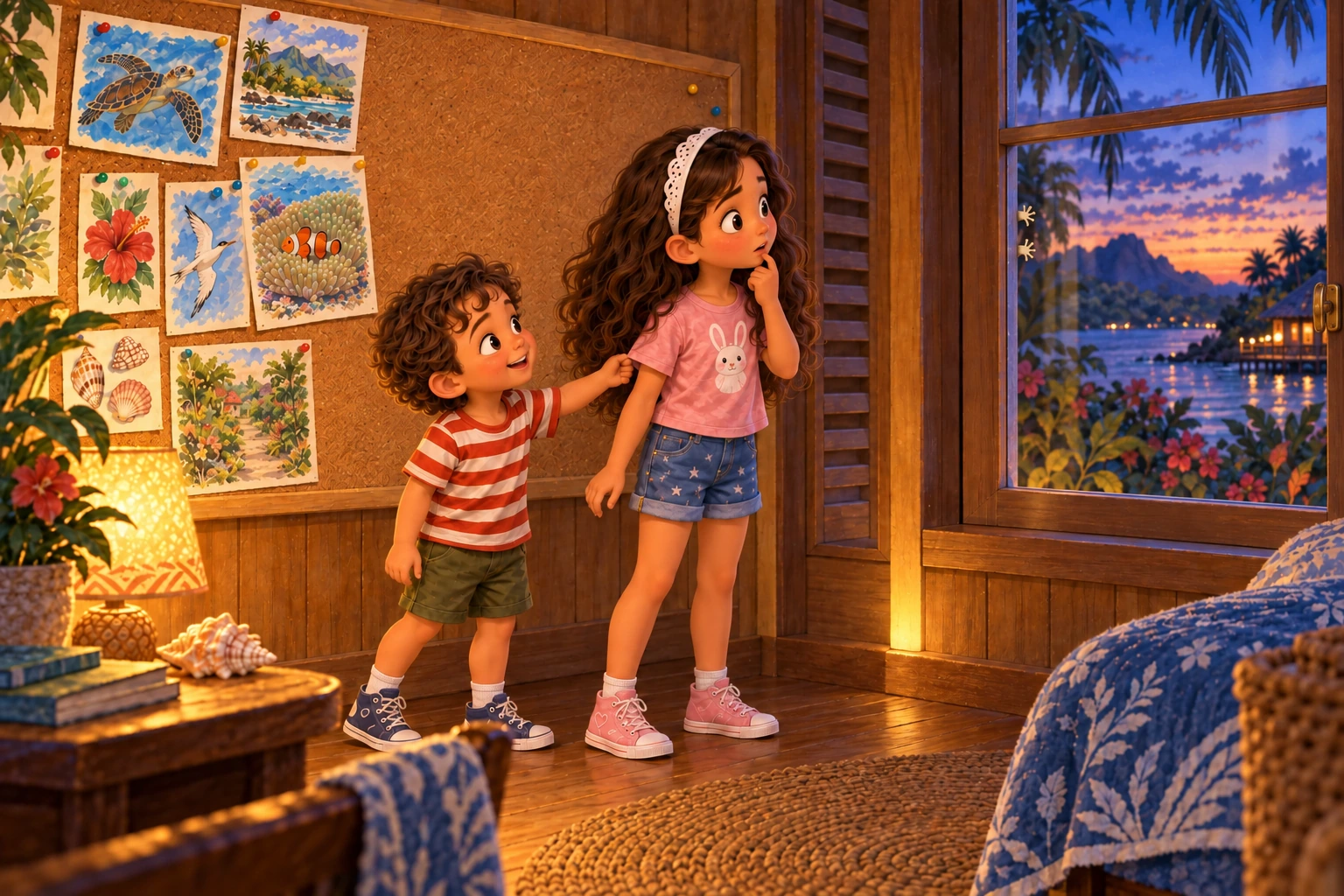
Liam notices two tiny gecko feet outside the window while Charlotte studies an empty space on the Wonder Wall.

Page 01

A very small arrival

Charlotte was making space on the Wonder Wall.

“Something BIG should go here,” she said.

Beyond the garden, the evening sea whispered.

Liam spotted five tiny toes against the outside of the glass.

Then another five.

He tugged Charlotte’s sleeve.

“How big?”
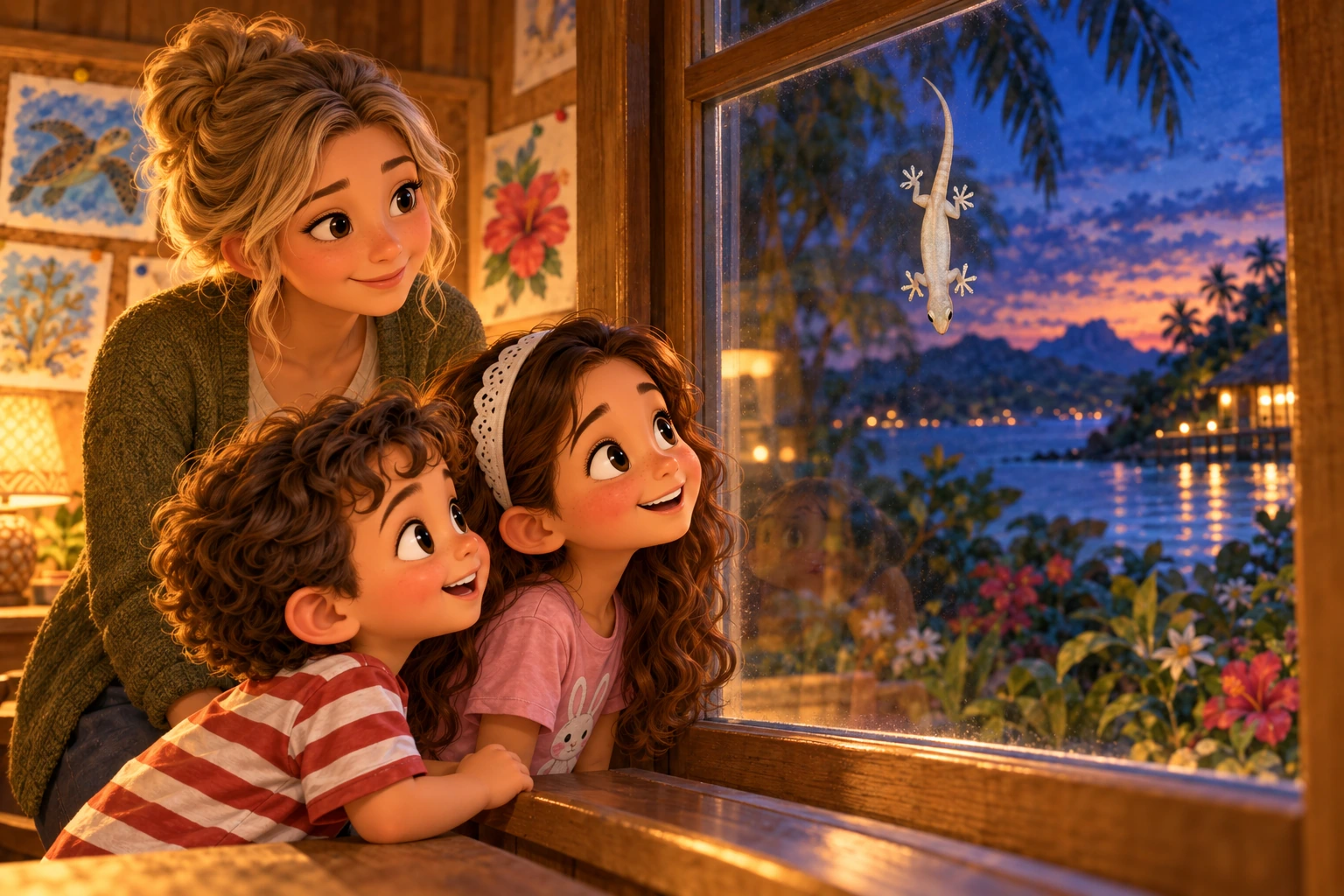
A pale house gecko clings head-down to the outside of the closed window as the children watch.

Page 02

The wrong way up

A pale little lizard crept into view.

It climbed straight up the window, turned, and came down headfirst.

“A house gecko,” said Mom, joining them.

Liam looked from its feet to his own.

“I can’t do that.”

“Neither can I,” Charlotte said.

The gecko paused upside down, perfectly comfortable.
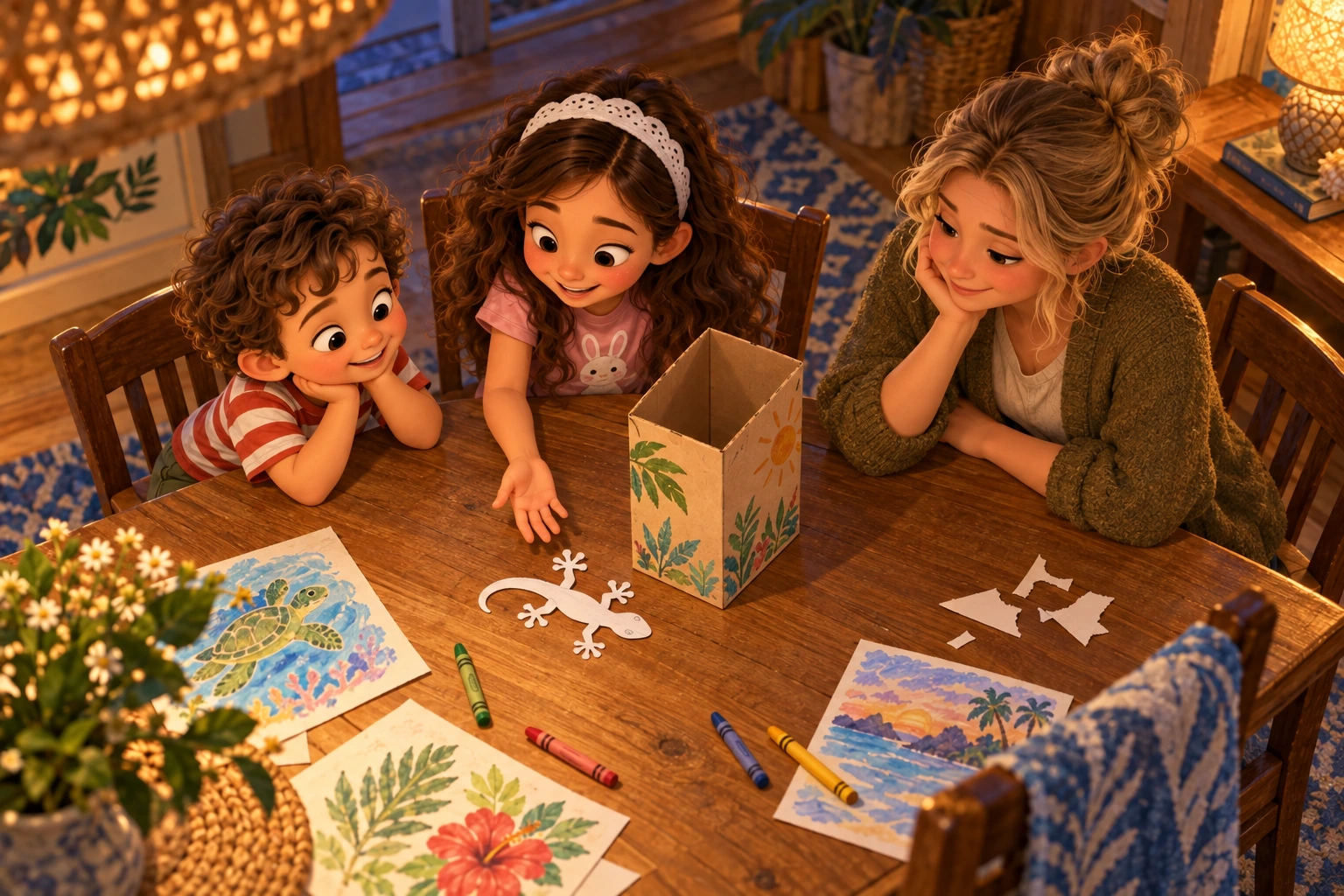
Charlotte’s paper gecko falls beside a cardboard box while Liam looks at its feet.

Page 03

A paper problem

At the table, Charlotte drew a gecko on a scrap of paper.

Mom cut it out. Charlotte held it against the side of a box.

She let go.

Flop.

“Ours needs something,” she said.

“Bigger feet?” Liam wondered.

Outside, the real gecko lifted one foot and kept climbing.

Pause & wonder

How could a foot hold on tightly and still let go?
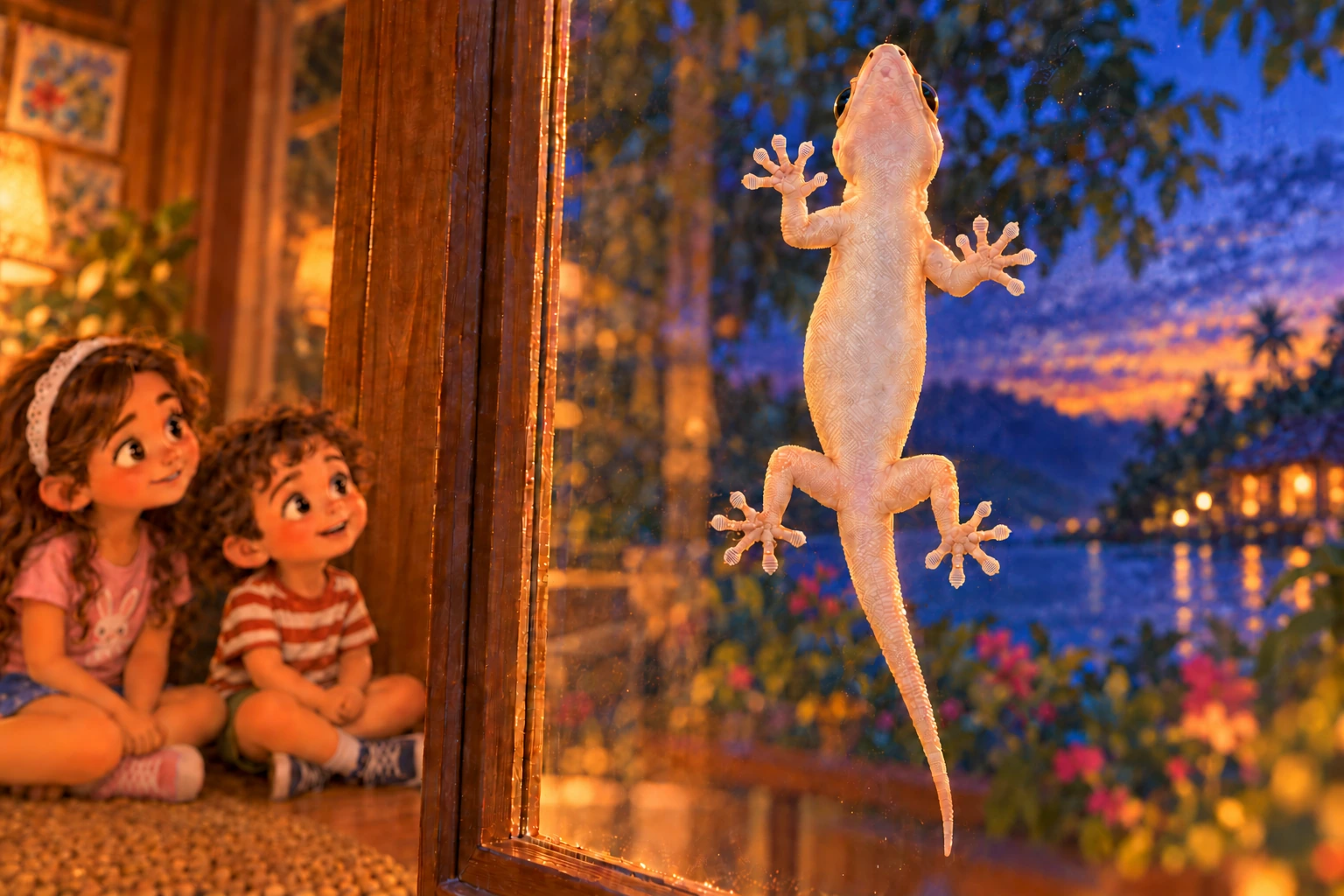
One of the gecko’s front feet lifts from the glass while Liam copies the motion with his fingers in his lap.

Page 04

One foot at a time

They returned to the closed window and watched quietly.

One foot held. Another lifted.

The toes curled away from the glass, then spread again.

Liam copied the movement with his fingers in his lap.

“It lets go a little at a time.”

Charlotte leaned closer without touching the window.

“What are we missing?”
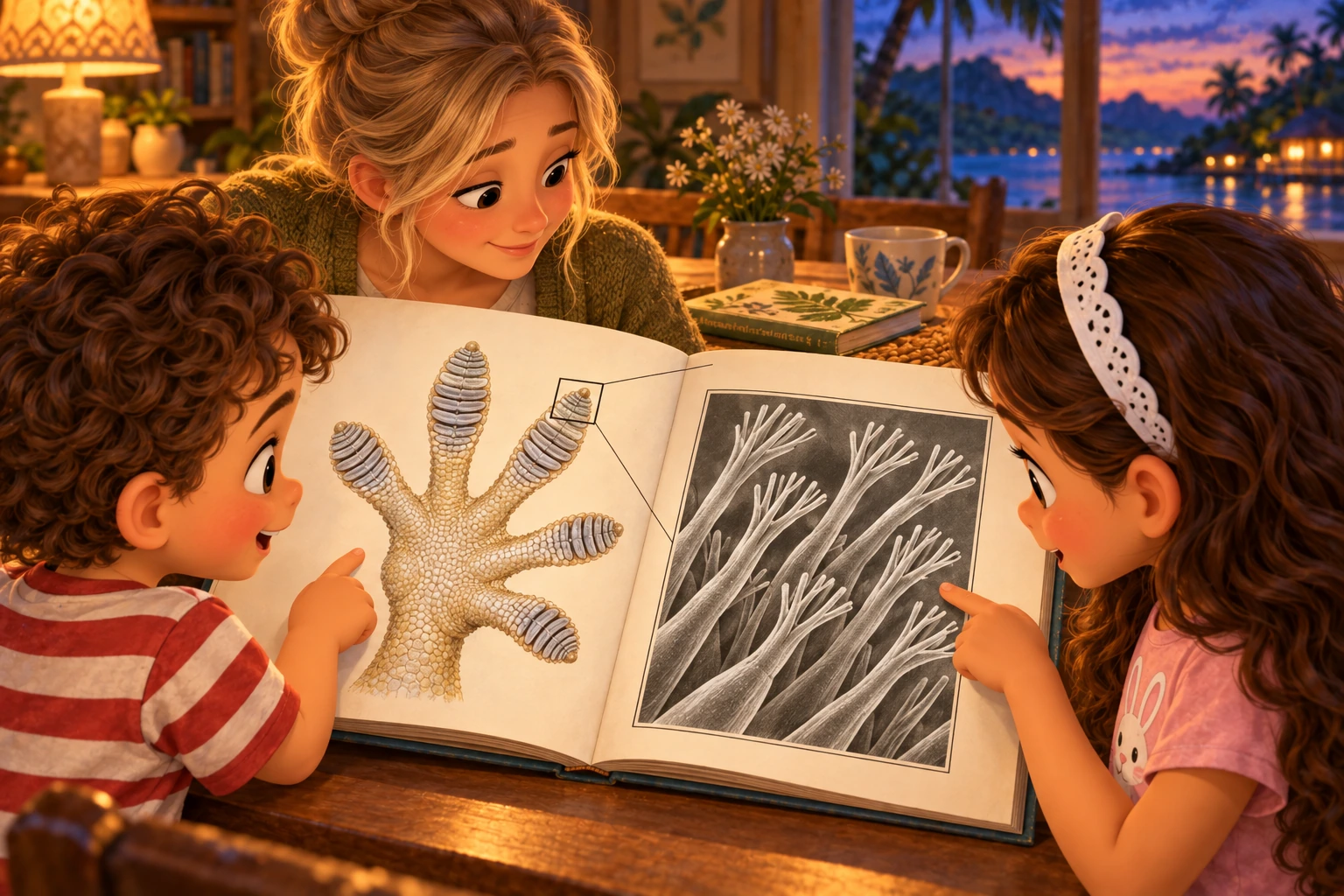
The children study a nature-book picture that enlarges the tiny branching structures under a gecko’s toe.
Enlarged view: the tiny branching structures beneath a gecko’s toe.

Page 05

Too small to see

Mom found a picture of a gecko’s foot in their nature book.

Beside it was a much bigger picture, made with a powerful microscope.

The toe looked like a forest of tiny hairs.

“Those help its toes get very close to the surface,” Mom read. “Close enough to cling.”

Liam studied the picture.

“All that fits on one TOE?”
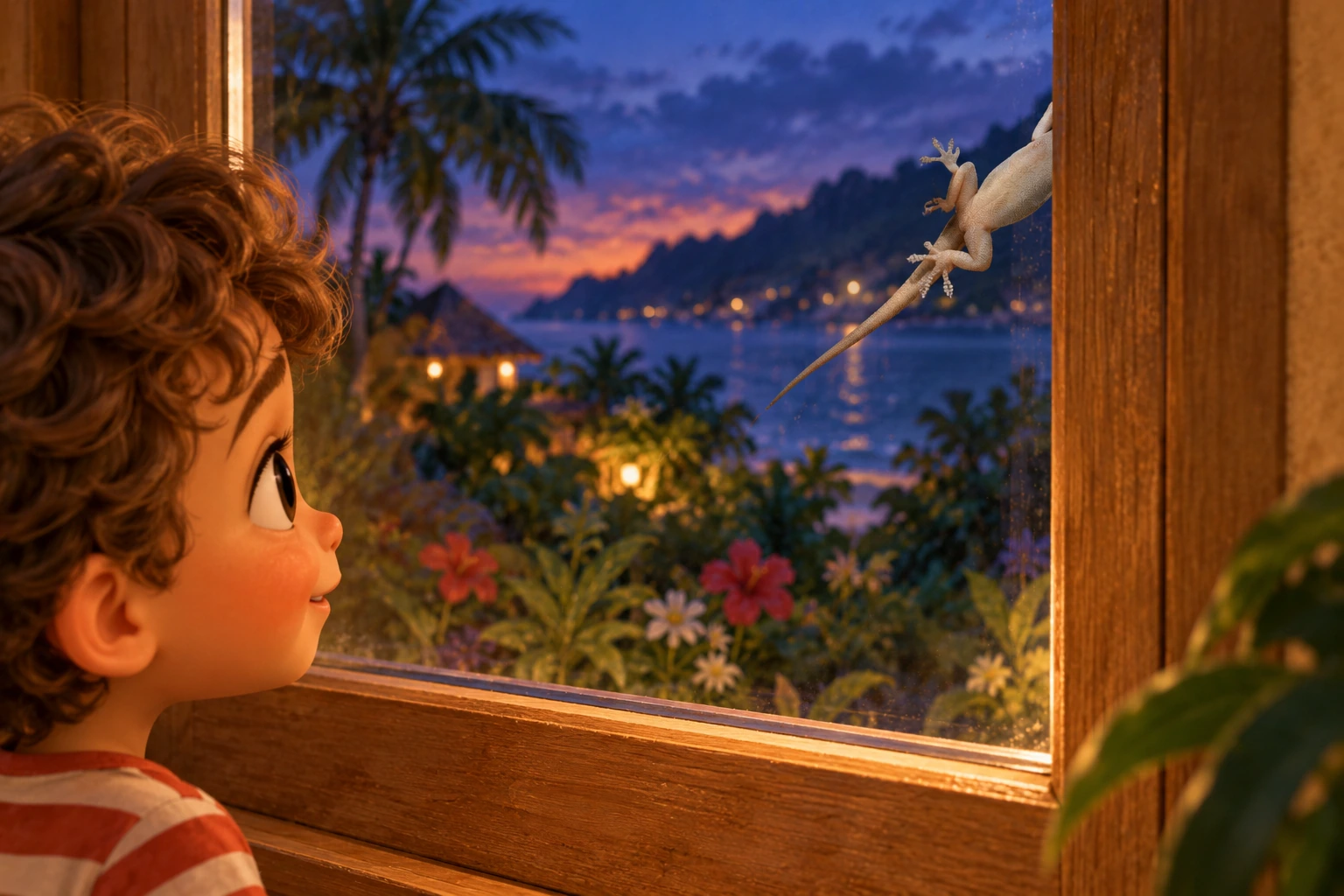
The gecko lifts a foot and slips beyond the outside window frame, with its tail disappearing last.

Page 06

The disappearing trick

Charlotte pointed to the gecko.

“But why doesn’t it get stuck?”

A front foot peeled free.

“That turn!” Liam said.

Mom checked the book. “Changing the angle helps release the grip.”

Charlotte watched the next step.

Then the gecko slipped beyond the window frame.

Four feet. A tail.

Gone.

Liam waited, hoping for one more toe.
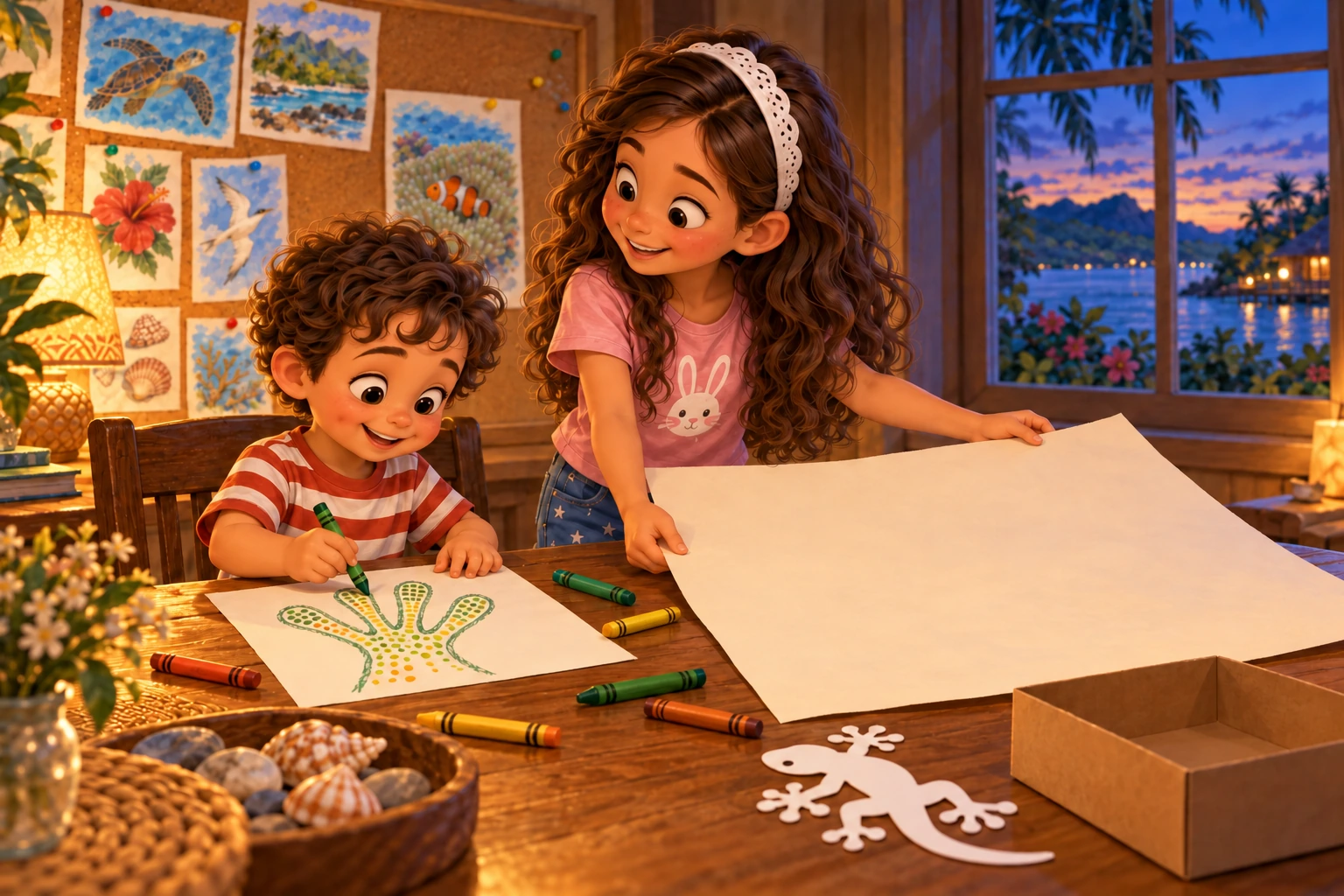
Liam draws a large gecko foot while Charlotte brings a bigger page for their tiny discovery.

Page 07

Room for something small

The window stayed empty.

Charlotte brought their paper gecko back to the table.

“Our paper can’t do everything its feet can,” she said.

Liam began another drawing.

First, a foot.

Then rows of tiny marks.

Charlotte pulled up a chair.

“We’ll need a bigger page.”

Liam grinned.

“For something very small.”
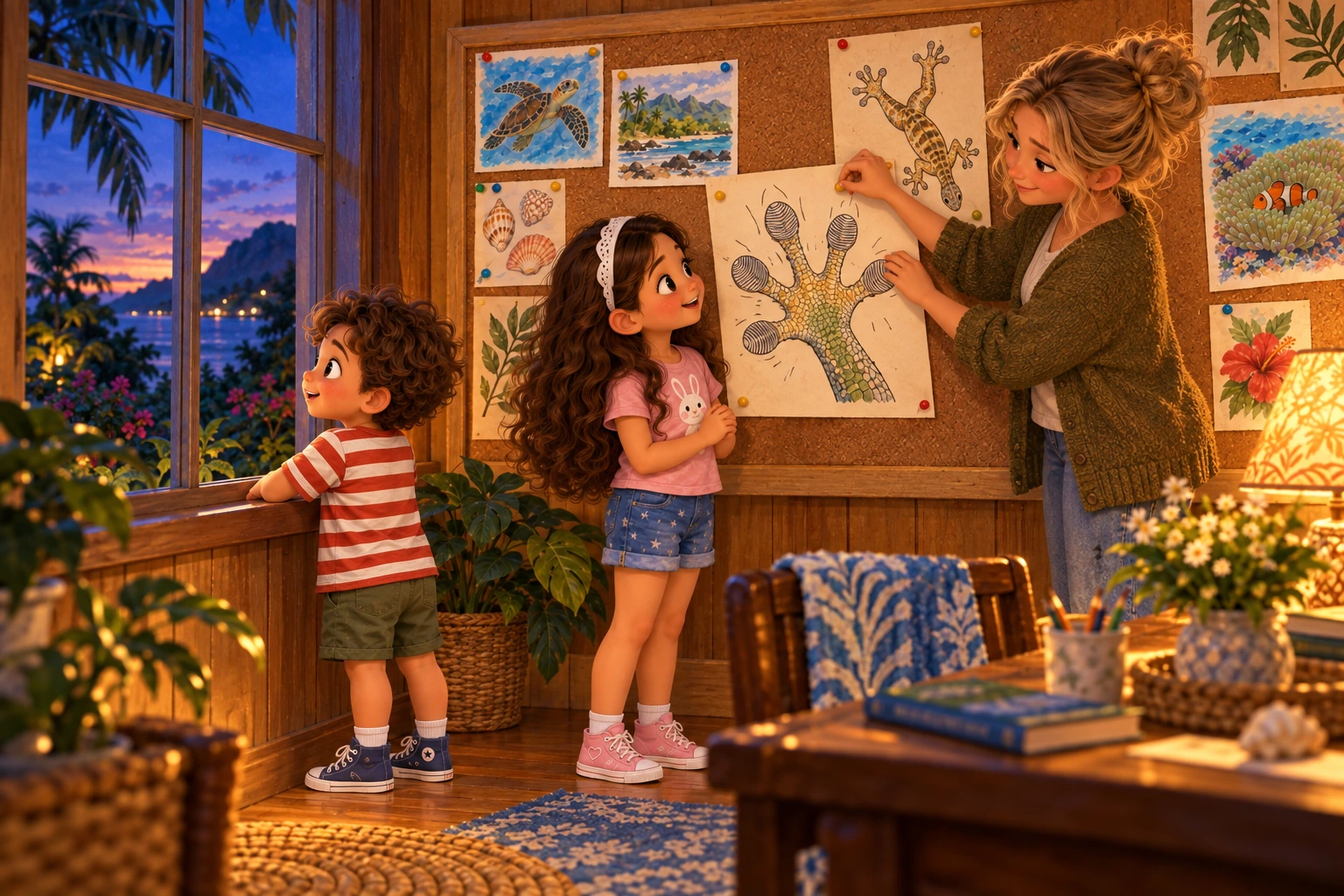
The family adds a large drawing of a tiny gecko foot to the Wonder Wall, and Liam turns toward a sound in the garden.

Page 08

A place on the wall

Mom helped them pin the new picture to the Wonder Wall.

An enormous drawing of one tiny foot.

Underneath, Charlotte wrote:

LOOK WHAT SMALL CAN DO.

Liam added the whole gecko beside it, upside down.

From the garden came a chirrup.

Then another.

Liam lifted his head.

“How do they make that noise?”

For curious families

Look what small can do

Explore the real feet behind our imagined visitor.

Meet the visitor

The illustration species is the common house gecko, Hemidactylus frenatus, also called the Asian house gecko. It is a small, slender, pale gecko often seen on house walls and windows at night. The story uses a fictional warm coastal island house and makes no claim about where the species is native.

How the feet work

The underside of adhesive toe pads carries microscopic, branching hairlike structures called setae. Their very close contact with a surface allows weak molecular attractions, called van der Waals forces, to add up. The feet do not work as suction cups or through sticky glue. The story’s “close enough to cling” is a simplified explanation.

Holding on and letting go

Toe position and the direction of force help the gecko attach and release its feet. The small movement Liam spots is a visible clue; the book supplies the explanation he cannot establish by watching alone. Published experiments on other toe-pad geckos support the general mechanism, not an exact angle or hair count for this species.

Watch without disturbing

Watch quietly from indoors with a grown-up. Leave the window closed and give the animal space. Do not tap on the glass, catch, handle, feed, or lure wildlife for a closer view. Keep both feet on the floor. These are conservative observation and child-safety practices.

Useful words

Gecko: a kind of lizard. Grip: hold on. Microscope: a tool that makes very small things visible. Setae: the scientific name for these tiny hairlike structures.

Sources for grown-ups
Make a big picture of a little thing Read again